

The Guide Michelin is considered the unofficial benchmark, Gault&Millau its key competitor, alongside other guides with their own distinct signature.
We at Bonvivant are featured in several of these guides and are often asked what the symbols actually mean. Here is our overview.
Guide Michelin: Stars, Bib Gourmand, and The Plate
The Guide Michelin originally began as a travel guide produced by a tire manufacturer; today, it is the most famous restaurant guide in the world.Its history started in 1900 in France: brothers Édouard and André Michelin published a small red book to give drivers tips on mechanic shops, gas stations, and inns, with the goal of encouraging travel and thereby increasing tire wear. Only in the 1920s did the focus shift entirely to gastronomy, and in 1926 the first star was awarded.
Its most famous symbol to this day is the star. In the German edition, it is awarded to restaurants whose cuisine meets particularly high standards, divided into three tiers.
„A kitchen full of finesse, worth a stop!"Two stars stand for top-tier cuisine worth a detour, three stars for unique culinary artistry worth a special journey. Below the stars, Michelin awards two additional distinctions.
- Guide Michelin, description of 1 star
The Bib Gourmand represents carefully prepared meals offering particularly good value for money, with featured restaurants falling into price categories between one and two euro signs.
The Plate (French Assiette) designates restaurants that are considered recommended but do not hold a star.
Important to know: Michelin assesses culinary performance exclusively. Ambiance and service do not factor into the stars; instead, there is a separate rating featuring up to five crossed knife-and-fork symbols.
Thus, a very simply furnished establishment can receive one or more stars solely for its cuisine. The awards are announced once a year per destination. Behind them are anonymous inspectors who pay for their own meals and keep their identity concealed; restaurants cannot apply.
The 5 Iron Criteria of Michelin Inspectors
To ensure global consistency, inspectors rely on exactly five pillars during every restaurant visit:1. Quality of the products used:
Freshness, selection, and culinary craft applied to ingredients.
2. Mastery of cooking techniques and flavor harmony:
Precise execution and the seamless balance of flavors.
3. Personality of the cuisine:
A clear, creative signature from the culinary team.
4. Value for money:
A fair balance between investment, quality, and final price.
5. Consistency over time:
Culinary performance must remain at the exact same high standard across every visit, whether on a quiet Tuesday evening or a fully booked Saturday.
Gault&Millau: Toques and Points
Gault&Millau was founded in 1965 by French restaurant critics Henri Gault and Christian Millau as a modern counter-model to Michelin. The founders positioned themselves as champions of the „Nouvelle Cuisine“, a movement that abandoned heavy roux sauces in favor of lightness, freshness, and the inherent flavors of the ingredients.The German edition has appeared since 1983. Instead of stars, it awards chef’s hats, known as toques, and a point system based on the French school grading scale from 0 to 20 points. The more points, the more toques: two toques correspond to roughly 13 to 14.5 points, four toques represent 17 to 18.5 points, while five toques mark the highest rating.
Gault&Millau also primarily evaluates culinary execution, with no separate designation for service or ambiance.
The major difference from Michelin lies in style: Gault&Millau does not limit itself to a list of symbols, but provides detailed restaurant reviews, the higher the score, the more extensive the write-up. Historically, it was also recognized as the guide that highlighted newer, more innovative culinary approaches early on. Additionally, Gault&Millau has published an annual wine guide since 1993, awarding wineries up to five grapes.
Other Restaurant Guides at a Glance
Beyond the two major names, several other guides play an important role, particularly in Germany.| Guide | How is it evaluated? | Special feature |
|---|---|---|
| Falstaff | Up to 100 points and forks | Rated by editorial team and Falstaff community |
| Der Feinschmecker | 1 to 5 Fs | Distinct criteria for cuisine, service, ambiance |
| Varta Guide | 1 to 5 diamonds | Covers hotels and restaurants |
| Schlemmer Atlas | Rated with spoons | Another well-known German restaurant guide |
| Der Große Restaurant & Hotel Guide | Custom rating system | Published by Wissen Media Verlag |
At Falstaff, ratings stem from both the editorial team and members of the Falstaff Gourmet Club, awarding points and forks. Falstaff also honors special concepts, such as Restaurant Bars of the Year. Der Feinschmecker awards ratings from one to five Fs and publishes an annual list of the best restaurants.
How the Systems Compare
| Feature | Michelin | Gault&Millau | Falstaff | Feinschmecker |
|---|---|---|---|---|
| Symbols | Stars, Bib Gourmand, Plate | Toques, points up to 20 | Points up to 100, forks | F from 1 to 5 |
| Focus | Purely cuisine, ambiance separate | Cuisine | Cuisine, service, wine, ambiance | Cuisine and overall impression |
| Inspectors | Anonymous inspectors | Food journalists | Editorial team and community | Editorial team |
| Style | Short summary | Detailed review | Rating with text | Rating with text |
How a Restaurant Gets Into a Guide in the First Place
Awards can neither be bought nor applied for. At Michelin, restaurants cannot simply submit an application; inspectors visit venues unannounced and multiple times.At Gault&Millau, food journalists perform the testing. Unlike Michelin, these are not full-time employed inspectors.
At Falstaff, votes from the community factor in alongside the editorial team. Anyone featured in a guide has primarily made an impression over an extended period: through consistent quality, word of mouth among guests, and a clear culinary signature.
This applies to major establishments just as it does to small bistros, because the systems evaluate what actually happens on the plate and in the room, not the name or budget of an operation. That is precisely what makes them credible and comprehensible to us.
The journey often unfolds step-by-step. Many restaurants are initially listed with a recommendation, a plate, or a Bib Gourmand before a star follows, while others see toques or points added gradually.
For a kitchen team, this means one thing above all: there is no evening where you can coast on a single showcase performance. That exact consistency, on a quiet Wednesday just as much as a packed Saturday, is the core of most evaluations.
Awards Beyond Classic Restaurant Guides
Not every accolade comes from a traditional guide. Falstaff, for instance, awards its own honors for bars and restaurant bars. For selection, more than 2,300 cocktail bars and 700 wine bars were reviewed, with only 850 cocktail bars and 440 wine bars included in the Falstaff Guide.The award relies on ratings from the Falstaff community and an expert jury. Alongside these are guest review platforms such as TripAdvisor, which highlight venues highly rated by travelers through the Travelers' Choice Awards.
Such awards showcase a different perspective than inspector visits: they reflect how guests experience a venue rather than how experts evaluate it. Both carry value, and together they create a more complete picture than any single rating, helping you place the various symbols in their proper context.
Plant-Based Fine Dining: Identical Standards for Vegetarians and Vegans
For a long time, fine dining moved along rigid tracks: classic luxury products like lobster, foie gras, or seafood were seen almost as prerequisites for top scores. In recent years, however, a shift in mindset has taken place. Entirely vegetarian and vegan restaurants are now rated at star level by major guides as well.For plant-based concepts, the exact same rigorous evaluation criteria apply as for traditional venues. There is no „sustainability bonus“ when assessing culinary performance. An award for plant-based cuisine confirms instead that vegetables, mushrooms, herbs, and fermentations achieve the same depth and complexity through master techniques, flavor balance, and precision as classic high-end menus.
What Hangs on the Wall at Bonvivant
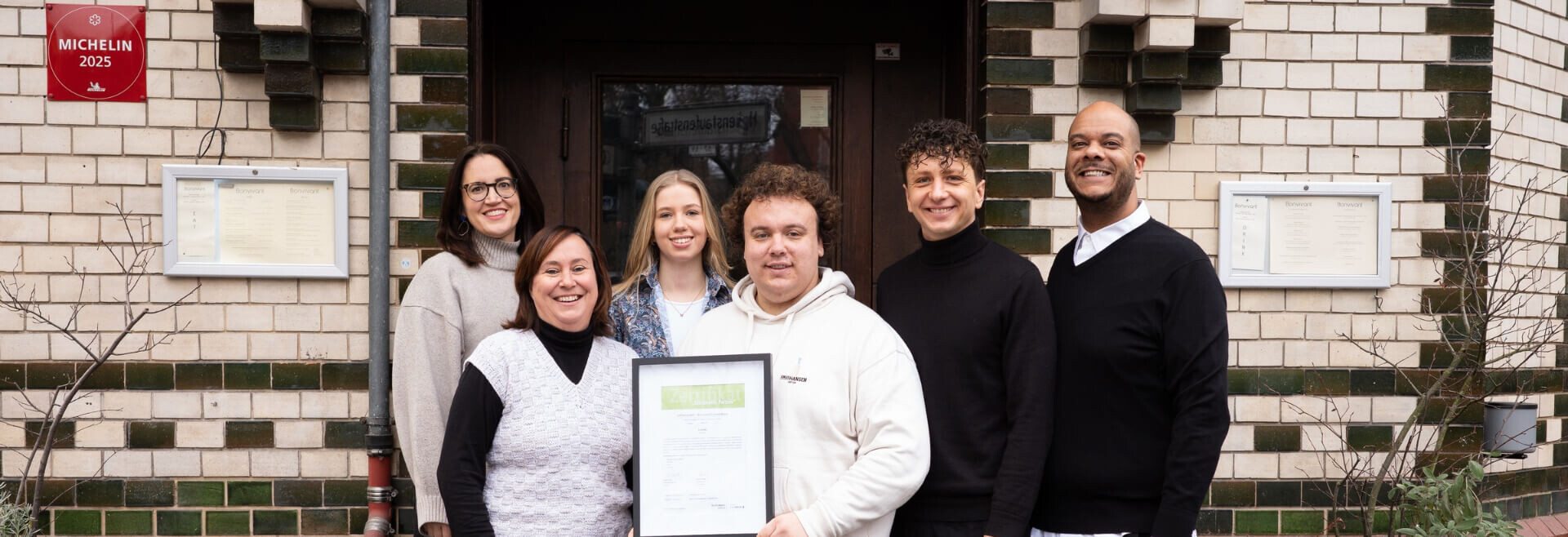
Our establishment is also featured in several of these guides. Bonvivant holds one Michelin star, which we first received in 2023. Gault&Millau rates us with two toques. In the current Falstaff Restaurant & Gasthausguide Deutschland 2026, Bonvivant stands at 90 points, with service receiving 19 out of 20, wine 18 out of 20, and ambiance 8 out of 10 points.We are also particularly proud of an award we received in 2024: Falstaff named us „Restaurant Bar of the Year“, an award that recognizes above all the synergy of kitchen and bar on an equal level. In Der Feinschmecker, Bonvivant stands with 2.5 out of 5 points on the list of best restaurants 2026.
What Awards Mean for You as Guests
A star or a toque is a guide, not a guarantee.Taste is subjective, and every guide measures by its own standards. That is why it pays to compare multiple sources rather than relying on a single symbol.
Anyone seeking a quiet evening might pay more attention to service and ambiance, while those prioritizing culinary artistry look to the food rating. The date matters as well: awards are reissued annually and can change.
For vegan restaurants, the exact same standards apply as for all others: at Michelin, the same five criteria, product quality, mastery of cooking techniques and flavors, personality of cuisine, value for money, and consistency, apply regardless of whether animal products are used.
An award for plant-based cuisine is therefore not a special category, but the very same judgment on craftsmanship and taste.
One thing is close to our hearts: an award says nothing about how an evening feels. A star does not automatically mean stiff, nor does a toque automatically mean expensive.
We see ourselves as a place where high-end cuisine and a relaxed atmosphere belong together; our team explains every course and drink pairing without anyone needing to dress up.
What This Means for Your Visit With Us
Above all: no one needs to feel intimidated by our awards.With us, you don't need to show up in an evening gown or suit, nor do you need to fear rigid etiquette. For us, stars and toques are recognition of our craftsmanship on the plate and in the glass, not an excuse for a distant atmosphere in the room.
We love fine dining that stays approachable. Our team explains every course and matching drinks with genuine enthusiasm, entirely free of jargon or pretense. Whether you are experiencing starred dining for the first time, celebrating an anniversary, or simply enjoying a relaxed evening with great food: we look forward to welcoming you all exactly as you are. All details on our current menu can be found on our website.
FAQs - Frequently Asked Questions
What is the difference between a Michelin star and a Gault&Millau toque?Michelin awards stars on a scale of one to three, evaluating cuisine exclusively; Gault&Millau awards toques and points up to 20, also for culinary execution, along with detailed restaurant reviews.
What does the Bib Gourmand mean?
A Michelin award for restaurants offering particularly good value for money; it does not evaluate culinary performance in the sense of stars.
How many toques can a restaurant receive in Gault&Millau?
Up to five toques, depending on the point score from 0 to 20.
Which awards does Bonvivant hold?
One Michelin star, two Gault&Millau toques, and 90 points in the Falstaff Restaurant & Gasthausguide Deutschland 2026. Bonvivant was also named Restaurant Bar of the Year by Falstaff.