
We are saying that right up front, because transparency is the absolute minimum when writing an article about one's own scene. We are part of this list. We know many of our colleagues personally. And we have a very clear opinion on what makes Berlin so unique in international fine dining.
This is not a neutral restaurant guide. It is our personal look at a city that thinks about fine dining differently than Munich, Hamburg, Paris, or Tokyo, louder, more unconventional, with more attitude and significantly less awe for rigid traditions.
While the release of the Guide Michelin 2026 showed that consistency in the capital is hard-won (three venues lost their star, no new one was added), the density of radical concepts in Berlin remains unmatched.
Here are the 9 addresses that occupy our minds the most; not only because people cook there at an extremely high technical level, but because each of these houses brings its own, unmistakable philosophy to the plate.
1. Rutz - The measure of all things in Mitte
The Rutz on Chausseestraße is and remains the culinary flagship of the capital. In 2026, it continues to be Berlin's only three-star restaurant and thus belongs to the exclusive circle of only twelve three-star addresses in all of Germany.
What chef Marco Müller and his team have been achieving for years is phenomenal. His cuisine is highly precise, strongly shaped by regional natural products, and technically flawless. But what makes Rutz a true Berlin role model for us is the atmosphere: despite the highest rating from the Guide Michelin, they completely dispense with stiff attitudes or reverent whispering. Rutz proves that world-class gastronomy can work with a natural casualness.
2. CODA Dessert Dining - The reinvention of the menu
Behind an inconspicuous, often graffiti-sprayed facade in Neukölln hides one of the world's most radical restaurant concepts. With CODA, René Frank created the first and only pure dessert restaurant in Germany to be awarded two Michelin stars.
Anyone thinking of a classic coffee afternoon or overly sugary desserts is completely wrong here. CODA uses patisserie techniques to craft a full evening menu. The refined use of natural sweetness, acidity, bitter notes, roasted flavors, and umami completely replaces refined industrial sugar. CODA fundamentally questions the classic sequence of appetizer, main course, and dessert. What connects CODA with us is the conviction that the drink concept must also be rethought, away from pure wine pairing toward complex pairings.
3. Tim Raue - The icon of the Asian flavor explosion
Hardly any chef embodies Berlin self-confidence as much as Tim Raue. His two-star awarded flagship in Kreuzberg near Checkpoint Charlie is world-famous. Raue deliberately dispenses with classic side dishes like bread, potatoes, or rice, as well as white sugar and dairy products.
Instead, he serves an uncompromising, Asian-inspired fine dining cuisine that relies on the interaction of spiciness, sweetness, and acidity. Dishes like his legendary Wasabi Langoustine are culinary monuments. The restaurant shows how you can deliver absolute top performance with an extremely clear signature style, worldwide success, and Berlin wit.
4. Nobelhart & Schmutzig - Politics on the plate
„Brutally local“ is the uncompromising mantra of owner Billy Wagner and chef Micha Schäfer at Nobelhart & Schmutzig in Kreuzberg. What does not come from Berlin, Brandenburg, or the immediate region does not enter the kitchen. That means: no pepper, no lemons, no olive oil, no chocolate.
Instead of tropical fruits and exotic spices, fermentation, pickling, aging, and the honest product of local farmers reign supreme. The restaurant, with its 28 seats around an open counter, understands gastronomy as a socio-political act. You do not have to share this radicalism in every detail, but you have to respect it: Nobelhart & Schmutzig forces the gastronomy scene to honestly question origins and supply chains.
5. Horváth - The discovery of roots
Right on Paul-Lincke-Ufer in Kreuzberg, Sebastian Frank cooks at the two-star awarded Horváth. Frank takes the Austrian cuisine of his homeland, literally breaks it down to its core, and reassembles it entirely anew.
Vegetables play a central role in his world of flavors, often intensified through long aging or unusual cooking techniques. Horváth impressively demonstrates how traditional regional cuisine can be transformed into an avant-garde fine dining experience without any kitschy romance.
6. Bonvivant - That is us
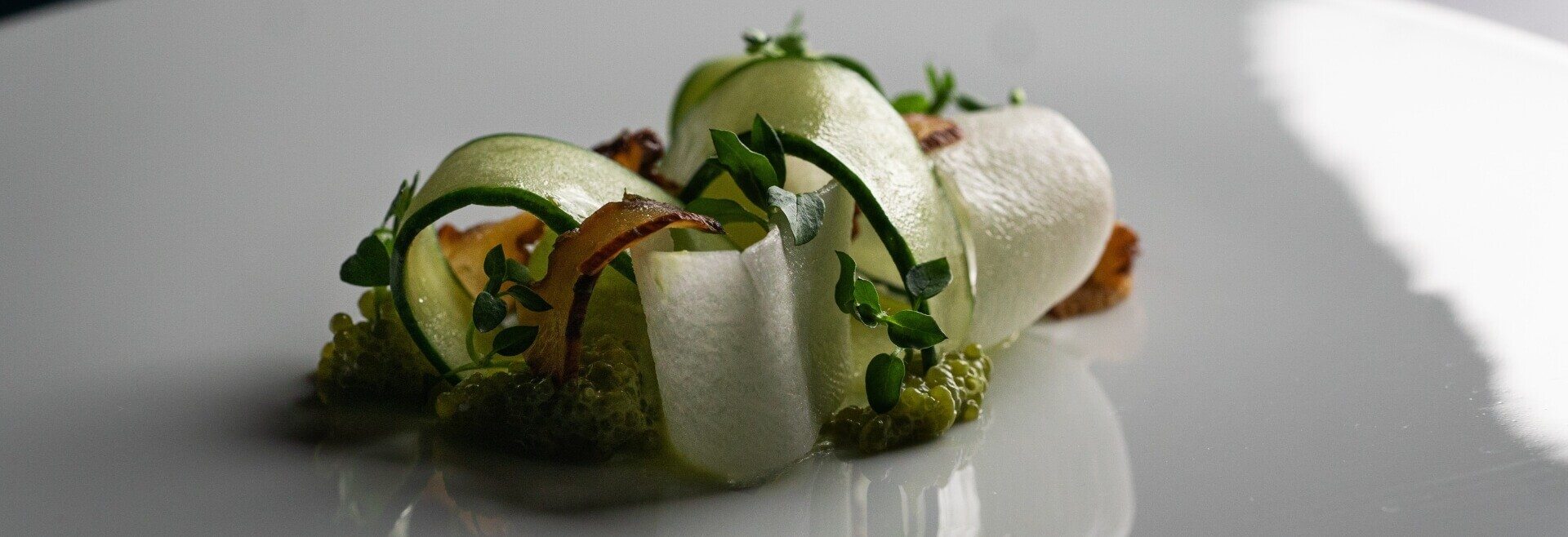
We at Bonvivant stand for star-level plant-based vegetable cuisine right in the middle of Schöneberg's Goltzkiez. We are the first and only purely vegan star restaurant in Berlin. With us, there are no animal products and no artificial substitutes; instead, we put vegetables, mushrooms, herbs, and craftsmanship at the absolute center.
Whether with our fine dining menu during the week or during our relaxed weekend brunch: we prove that purely plant-based enjoyment is not a statement of renunciation, but an enrichment for modern gastronomy.
7. Cookies Cream - The pioneers of plant-based enjoyment
Anyone talking about plant-based fine dining in Berlin cannot bypass Heinz „Cookie“ Gindullis and chef Stephan Hentschel. Cookies Cream in the backyard Unter den Linden has been cooking vegetarian since 2007 and has held a Michelin star since 2018.
The restaurant paved the way and proved that a vegetarian concept in a club atmosphere can be star-worthy. Unlike us, Cookies Cream cooks vegetarian; classics like the parmesan dumplings are a firm part of the house's identity. It remains one of the most important institutions in the city for anyone seeking meatless fine dining in a casual atmosphere.
8. hallmann & klee - The magic of the neighborhood
At Böhmischer Platz in Neukölln, Sarah Hallmann and her team at hallmann & klee show how modern a neighborhood restaurant can be. Awarded one Michelin star, the house combines craftsmanship perfection with a warmth that you usually only know from familiar local spots.
The kitchen focuses on clear, reduced flavors, excellent basic products, and an unpretentious aesthetic. hallmann & klee is the best proof that fine dining in Berlin does not have to take place in a luxury hotel, but can thrive right in the middle of a residential quarter.
9. Bandol sur mer - Rock 'n' roll in the garage kitchen
On Torstraße in Mitte lies Bandol sur mer, arguably one of the most unusual star addresses in Germany. Once started as a tiny kebab shop, the team around Stéphane Chang has been cooking at a star level here for years. In a narrow, hose-like room, you sit right at the open kitchen, watch the chefs work, and experience a French-influenced avant-garde cuisine without any frills.
Bandol sur mer proves the pure Berlin spirit like hardly any other house. Here, it is not the expensive tablecloth or the imposing entrance area that counts, but the absolute passion on the plate and the unconstrained approachability right in the hustle and bustle of Torstraße.
What this list says about Berlin Fine Dining
Looking at these addresses, it quickly becomes clear: Berlin does not speak a uniform culinary language. There is no single template according to which a star restaurant has to work here. While cities like Paris or Vienna are heavily shaped by their history, Berlin defines itself through change and deliberate rule-breaking.
CODA questions sugar, Nobelhart & Schmutzig questions imported goods, Rutz questions the dress code, and we question the necessity of animal ingredients in fine dining.
It is precisely this diversity that keeps the Berlin scene so vibrant. The city's 19 star restaurants are not museums, but workshops for new ideas.
In the end, everyone really finds something to their taste in this city because the scene is so endlessly multifaceted. Regardless of whether you are looking for the uncompromising elegance of a multi-course menu or simply letting yourself drift, Berlin naturally offers wonderful addresses, small bistro treasures, lively neighborhood spots, and international street kitchens around every corner that redefine the capital's gastronomic DNA day after day.
Comparison: Special Berlin Michelin-starred restaurants 2026
| Restaurant | District | Stars | The Unique Selling Proposition |
|---|---|---|---|
| Rutz | Mitte | ★★★ | Berlin's only three-star restaurant; relaxed three-star culture |
| CODA Dessert Dining | Neukölln | ★★ | Germany's only two-star dessert restaurant |
| Restaurant Tim Raue | Kreuzberg | ★★ | Asian-inspired high-end flavors without dairy products & sugar |
| Horváth | Kreuzberg | ★★ | Radically liberated Austrian vegetable cuisine at a two-star level |
| Nobelhart & Schmutzig | Kreuzberg | ★ | Brutally local: exclusively ingredients from Berlin & Brandenburg |
| Bonvivant | Schöneberg | ★ | Berlin's first and only purely vegan star restaurant |
| Cookies Cream | Mitte | ★ | Berlin's oldest vegetarian star restaurant with a club history |
| hallmann & klee | Neukölln | ★ | Perfect symbiosis of star-level quality and genuine neighborhood hospitality |
| Bandol sur mer | Mitte | ★ | Intimate garage atmosphere on Torstraße with French fine dining |
FAQs - Frequently Asked Questions
- How many Michelin-starred restaurants are there in Berlin in 2026?
- In 2026, there are a total of 19 restaurants in Berlin with at least one Michelin star: one three-star restaurant (Rutz), four two-star restaurants (CODA, FACIL, Horváth, Tim Raue), and 14 one-star restaurants. In total, 28 stars shine over the capital.
- Which is the best restaurant in Berlin?
- Purely by Guide Michelin ratings, Rutz in Berlin-Mitte is the highest-awarded restaurant in the city with three stars. Which house is „the best“, however, depends on personal taste: those looking for complex desserts go to CODA; those who appreciate radically regional ingredients choose Nobelhart & Schmutzig; and those wanting to experience purely plant-based fine dining come to us at Bonvivant.
- Are there purely vegan star restaurants in Berlin?
- Yes! Bonvivant in Berlin-Schöneberg is the first and only purely vegan star restaurant in the capital. Cookies Cream also cooks plant-based, but is characteristically vegetarian with vegan options.
- How much does a menu cost in a Berlin star restaurant in 2026?
- Prices vary depending on category and concept. In one-star restaurants, menu prices in the evening are usually between 130 and 190 euros per person (excluding drinks). In two- and three-star houses like CODA, Tim Raue, or Rutz, menus often range between 220 and 380 euros.
- Is there still a Green Michelin Star?
- Currently, coverage and ratings by the Guide Michelin focus primarily on the classic red stars for culinary excellence. However, sustainability, craftsmanship integrity, and regional responsibility have long ceased to be a special distinction for pioneering businesses in Berlin, standing instead as the natural foundation of daily operations.