


„In a restaurant, you are served, you feel a bit like a king."According to Klotter, it is precisely this feeling of being served for an evening and being allowed to present oneself that boosts self-esteem. For this to emerge in the first place, however, the environment must be right. We will tell you what we pay special attention to here in Goltzstraße, and why these details carry just as much weight for us as what lands on the plate.
- Christoph Klotter, Nutritional Psychologist, Fulda University of Applied Sciences
The First Impression Counts More Than You Think
People subconsciously evaluate a new environment within the first few seconds, long before consciously thinking about it. If a reception feels rushed or inattentive, a subtle tension persists throughout the evening. A calm, welcoming greeting, on the other hand, acts like a signal: you can arrive here. That is precisely what we place great value on; our service team is meant to guide you through the courses of the menu without appearing stiff or formal.This mix of attentiveness and ease is no coincidence, but part of our self-image as a place for epicureans that we have preserved since our founding in 2019. For us, it is not about choreographing every single move, but about giving our team enough freedom to respond to the mood at each individual table, whether you want to be deep in conversation or prefer to be left in peace.
Space and Atmosphere: More Than Just Decor
How a room is designed has been proven to influence how relaxed or tense guests feel. Environments that are too cool or clinical quickly feel unwelcoming, while warm, thoughtful spatial concepts invite you to linger. Our house on Goltzstraße is located in a listed historic building with a red-brick facade. Behind it, however, no stiff, historical ambience awaits you, but a bright, vibrant space with a green-and-red interior and plenty of green plants that still does not feel overcrowded. We deliberately mix rustic elements like wood and brick with modern, urban accents so that the room feels warm and inviting rather than cold and overly styled. For larger groups or special occasions, we also have our own gallery room featuring a large, round wooden table, also surrounded by plants. A setting that we have intentionally kept informal, more living room than banquet hall. Through all of this, it was important to us that our restaurant feels like a convivial gathering rather than the distant formality known from classic starred restaurants. Even with a star, we wanted to remain a place where you do not have to dress up or pretend at the table.
The Soundtrack of the Evening: How Music Influences the Pace
Background noise also shapes how a restaurant visit is experienced. It is well documented that fast, loud music accelerates eating behavior, an effect that chain restaurants, for instance, use deliberately to turn tables over faster. Slower, calmer sounds, by contrast, have a decelerating effect and invite guests to stay longer and enjoy more consciously.Because our team personally explains every course and its matching beverage pairing to you, a calmer acoustic environment naturally suits us better than a loud, hectic room where there would hardly be time for such explanations anyway.
Words That Prepare the Palate
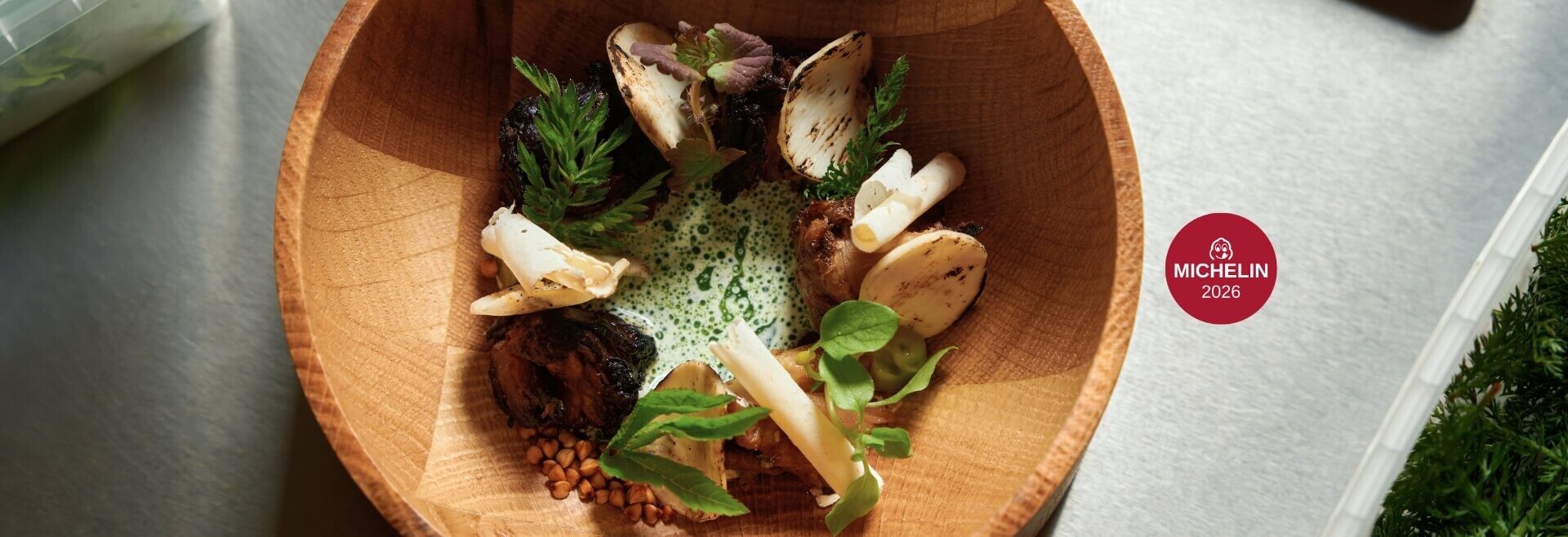
The language on a menu also influences how a dish is perceived. In behavioral economics, it is well established that descriptions indicating the origin, craftsmanship, or texture of a dish shape expectations positively even before the first bite is served. A dish that we describe as „Kohlrabi from Bioland Farm Zielke with fir, elderberry, and black apple" evokes different associations than a simply named „Kohlrabi with cream". That is why we list the producer's name and origin of the ingredients on our menu; it makes the connection to our region and seasonal producers visible to us without needing artificially flowery language.
Tactility: Why Quality Should Feel Tangible
Perception does not only happen through the eyes and palate; the sense of touch also plays a role in how premium an experience feels. Lightweight, rattling cutlery or thin napkins subconsciously send a different signal than heavy cutlery and high-quality materials. We cannot prove this in figures, but our choice of materials, from the interior to the tableware, is important to us because it is meant to show how much craftsmanship goes into our work from the kitchen to the table. This attitude is also reflected in the fact that we deliberately do not replace tableware and glasses prematurely just because they no longer look pristine, less out of frugality and more because we want to avoid unnecessary consumption. This is part of our broader sustainability concept.
Hospitality That Explains Instead of Just Serving
A dish whose origin and preparation are explained is experienced differently by guests than one that lands on the table without comment. That is precisely why we personally introduce each course and its matching drink to you instead of simply serving them. For you, this means less guessing about what exactly is in front of you and more opportunity to consciously engage with individual flavors, an effect that aligns with what we know about descriptive language on menus, only in direct conversation rather than on paper.
Schöneberg as a Frame for Deceleration
Our location also shapes how a visit with us is experienced. Goltzstraße in Schöneberg, which we have called home since 2019, is a lively but not hectic dining strip, a neighborhood character that differs from the tourist bustle of other Berlin nightlife districts. This environment supports the exact atmosphere we want to create: a place where you can come to rest without sacrificing culinary ambition. When it comes to the dress code, we also deliberately avoid strict requirements common in many starred restaurants; casual clothing is explicitly welcome here. A small signal that means a lot to us: enjoyment should not be confused with tension.
What This Means for Your Visit to Us
A successful restaurant evening is rarely the result of a single factor for us. Reception, room atmosphere, music, language, and tactility work together here and help decide whether you can truly unwind. These factors cannot be viewed in isolation from one another: a perfectly designed room is of little use if the service feels rushed, and the finest menu language fizzles out if the dish behind it fails to deliver on its promise. Only in their interplay does that feeling of coherence arise which one often cannot name, but immediately feels.
FAQs - Frequently Asked Questions
- Why do some restaurant visits feel more relaxed than others?
- Besides the quality of the food, subconsciously perceived factors such as the reception, room atmosphere, background noise, and material selection play a major role in how relaxed a visit feels.
- What kind of atmosphere can I expect at your restaurant?
- A bright, green-and-red room, as well as a service team that personally explains each course and the matching beverage pairing to you.
- Why do you describe the origin of your ingredients so precisely on the menu?
- Because we want to show you where our products come from; for us, this creates a direct connection between you, our region, and seasonal producers.
- Where exactly is Bonvivant located?
- On Goltzstraße in Berlin-Schöneberg, a lively yet not touristically overcrowded neighborhood.