
What Is a Tasting Menu?
The word tasting comes from the French and means roughly to sample or try. A tasting menu is a set sequence of several small courses put together by the chef to showcase as many flavors, textures, and techniques as possible in one meal. Instead of one large main course, you receive many small plates one after another, usually in portions that are intentionally smaller than in a conventional meal.„The goal is not to get full, but to explore."In English, the format is called a tasting menu, and in French, Menu Dégustation. There is no difference in meaning between the terms; they refer to the exact same format. The counterpart is à la carte dining, where you choose individual dishes freely from the menu and pay for each one separately.
- hiddentable.de, fine dining magazine
Where Does the Tasting Menu Come From?
Its roots cannot be pinpointed to a single date. One important predecessor is Japanese Kaiseki, whose origins date back to the 16th century and which consists of several small courses. In France, ordering from a menu became widespread at the end of the 19th century, associated with chef Auguste Escoffier and still common in most restaurants today.The tasting menu as we know it today developed instead with the Nouvelle Cuisine of the 1960s and 1970s. This movement focused on lighter dishes, smaller portions, and seasonal ingredients, allowing chefs to present more ingredients, flavors, and techniques over the course of an evening. Sources place the modern form differently at times, with some seeing it already in early 20th century French kitchens. Everyone agrees on one thing, however: today, the tasting menu is the signature format of fine dining worldwide.
Tasting Menu or À La Carte: The Difference
| Feature | Tasting Menu | À La Carte |
|---|---|---|
| Selection | Set sequence, often without choice | Free choice of individual dishes |
| Portions | Several small courses | Classically starter, main course, dessert |
| Pace | Set by the kitchen team | Set by you |
| Price | Flat rate for the entire sequence | Each dish individually |
| Idea | Experience the kitchen's signature style | Find what suits your own appetite |
The price difference in particular surprises many people: menus are often less expensive than a comparable combination of individual dishes, and they allow the kitchen to plan much more precisely. For guests, that means a well thought out overall experience where you do not have to decide.
How Many Courses Does a Tasting Menu Have, and How Long Does It Take?
Depending on the restaurant, such a menu usually includes between five and twelve courses, and some sources even mention more. With us in the evening, it is six or seven. The duration depends on the number of courses; for a menu with beverage pairings, two to four hours is often estimated. Do not schedule the evening between two other appointments, but give it time. Between courses, pauses naturally arise in which you can chat and savor what you have eaten; they belong to the concept and are not a sign of slowness.
The Arc of the Evening: How a Menu Is Structured
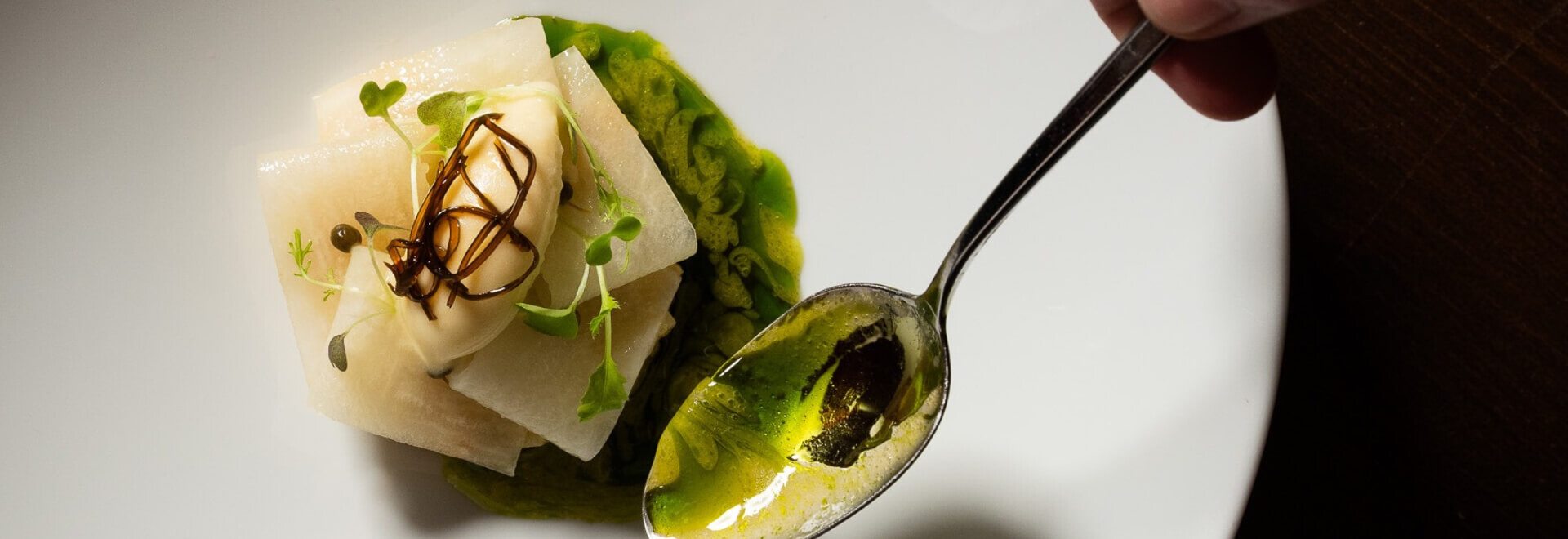
A classic menu of this kind follows an internal dramatic arc: it starts light, grows more complex, and finishes sweet. At the beginning there is often an amuse-bouche, a tiny bite that sets the palate. Cold and hot starters follow, along with intermediate courses and a main course, and at the end dessert and small sweets with coffee, known as petit fours. On our sample menu, the evening begins with cucumber and ends with cherry. For each course, the menu lists one main ingredient plus two or three accompaniments, such as charcoal, wheatgrass, and wild herbs for the celeriac course. So the menu does not list recipes, but the flavors from which the dish is created. Our menus change with the seasons, so the dishes on the menu are examples and may differ when you visit.
Three Variations: Set Menu, Menu with Choice, Surprise Menu
Not every menu works the same way. Some restaurants offer a set menu without choice, while others let you pick between several dishes for individual courses. Still others serve a surprise menu where you do not know the sequence in advance and the chef puts it together based on the ingredients currently available. For us, the rule is: normally, in the evening we serve exclusively our set course sequence of six or seven courses. When the evening allows, we can in exceptional cases offer individual courses or a menu to share; please let us know this wish in advance when making your reservation.
With or Without Beverage Pairing
A menu like this is often accompanied by a beverage pairing, classically a wine pairing where a matching glass is served with each course. With us, it is called a drink pairing and is a standalone part of the evening that you can choose either alcoholic or non alcoholic. On our sample menu, the courses are paired with sake, sherry, pisco, mate, or umeshu, each combined with other flavors such as nori, bergamot, shiso, or apricot. The principle is the same as with the food: every glass is tailored to a course and continues its story of flavors. You can read more about this in our article on balanced drinks.
Vegan Tasting: A Plant Based Menu
Many people associate a tasting menu with meat and fish, yet the format is not tied to that. With us, the entire menu is vegan. That demands a great deal from the kitchen, because depth, texture, and variety have to come from plant based ingredients alone. To achieve that, we work with techniques such as fermentation, long reductions, and using ingredients from root to leaf. For a menu of this kind, that is an advantage, because each course highlights a different vegetable, a different technique, or a different flavor. You can learn more about this in our article on fermentation.
Tips for Your First Tasting Menu
A few simple things help you enjoy the evening:- Book early and mention allergies, intolerances, and special requests when making your reservation.
- Allow plenty of time; a multi course evening is not an appointment squeezed between two others.
- Let yourself be surprised instead of reading up on every course beforehand; the appeal lies in discovering.
- Ask questions if something interests you; our team is happy to explain every course and the matching drink.
- Decide in advance whether you would like the beverage pairing, as it is its own part of the evening.
Who Is a Tasting Menu Worth It For?
A tasting menu is not for every occasion. Anyone looking for a quick and uncomplicated meal is better off with à la carte dining or brunch. On the other hand, anyone who feels like immersing themselves in a kitchen for an evening, trying new things, and handing over the choice will find it a special experience. It suits anniversaries, birthdays, and dates just as well as anyone who is simply curious about craft and flavor. If you are still unsure, you can get to know our kitchen first at brunch, which we serve Friday to Sunday from 9 a.m. to 3 p.m.
Tasting Menu in Berlin: Our Menu at Bonvivant
We serve dinner and drinks Wednesday to Saturday from 6 p.m. The menu comes with six or seven courses, and filtered water and an espresso are always included. For all courses, we offer an equivalent gluten free option, and we are also happy to accommodate lactose, nuts, or other allergens; please let us know about this when booking. You can find current prices on our menu, and anyone who wants to read more about the concept beforehand will find further information on our page. You can also learn more about how our evening flows in our article on vegan fine dining.
FAQs - Frequently Asked Questions
What is a tasting menu?A set sequence of several small courses put together by the chef to showcase different flavors and techniques in one meal. The word tasting comes from the French and means to sample.
How many courses does a tasting menu have?
Usually between five and twelve, depending on the restaurant. With us in the evening, it is six or seven.
Do you get full from a tasting menu?
The individual portions are small, but many courses together add up to a complete meal. The goal is discovery, not getting full.
What is the difference between a tasting menu and a degustation menu? None; both terms refer to the same format: a set sequence of several small courses. In French it is called Menu Dégustation.
Where can you find a vegan tasting menu in Berlin?
With us at Bonvivant at Goltzstraße 32 in Berlin Schöneberg, Wednesday to Saturday from 6 p.m., with six or seven courses.
Do you offer a non alcoholic tasting menu?
Yes, the drink pairing is available either alcoholic or non alcoholic.