

Headlines like these quickly suggest a U-turn in consumer behavior: Was the whole thing in the end just a short-lived fad of a hip big-city bubble?
At the same time, the reality on the ground paints a completely different picture: According to the global HappyCow ranking 2025, Berlin ranks internationally in second place among the most vegan-friendly cities in the world; directly behind London and even ahead of metropolises like New York, Los Angeles, or Bangkok. Both exist simultaneously, and exactly this apparent paradox makes the current situation so exciting.
Anyone who wants to understand the developments must not stop at superficial headlines. We have looked closely at the current market numbers, statistics, and industry reports: From the tense situation of Berlin gastronomy to structural changes in food retail to the dynamics on social media and the maturation processes on the consumer side. The result is a differentiated stocktaking of an industry in transition, showing: We are by no means experiencing the end of plant-based cuisine, but rather its transition from a loud hype phase into a sustainable normalization.
Berlin's vegan restaurant scene: Robust growth despite historic gastro crisis
To realistically assess the situation of vegan restaurants in Berlin, one must first consider the framework in which gastronomy overall is currently moving. The industry is nationwide, and especially in Berlin, in one of the most difficult phases of recent decades. Cumulative cost increases for food and energy of around 30 percent, the shortage of skilled labor, and the return to the regular VAT rate are hitting many businesses hard. According to current calculations by industry observers and associations, up to 30 percent of Berlin gastronomy businesses could be forced to give up in the coming years. In the past year alone, the city recorded around 2,900 insolvencies and business closures in the hospitality industry. Prominent and established addresses like Tante Fichte in Kreuzberg or Osterberger in Neukölln had to close their doors in this extremely challenging environment.
Against this gloomy backdrop, however, the capital's vegan and vegetarian scene shows itself to be surprisingly resilient. Berlin currently counts over 100 purely vegan restaurants and far more than 450 gastronomy businesses with an explicitly declared, extensive plant-based offering. In the past year alone, the number of addresses listed as vegan-friendly grew by around 7 percent. Of course, purely plant-based concepts are not spared from market changes either: Former pioneer projects and classics of the Berlin scene like The Bowl in Friedrichshain or the vegan pizzeria Sfizy Veg in Neukölln no longer exist today. But industry experts by no means view these departures as a symptom of an industry-wide decline, but rather as normal fluctuation in a saturated, highly dynamic market.
An interesting observation here is which businesses fail in the current market environment and which remain successful. The wave of business closures in overall gastronomy mainly hits places without a clear culinary profile, meaning: the average exchangeable.
In contrast, there are concepts with an unmistakable identity, uncompromising quality, and a clear stance. Whether puristic Japanese specialty cuisine, focused natural wine bars with a small menu, or uncompromising vegan fine dining: A sharpened profile and craft excellence are more important for survival in the market today than the sheer decision of whether a restaurant is oriented omnivore, vegetarian, or vegan.
| Key figure / Indicator | Current value / Development |
|---|---|
| Purely vegan restaurants in Berlin | over 100 businesses |
| Vegan-friendly venues total (with extensive offering) | over 450 businesses |
| Growth of vegan-friendly addresses (previous year) | approx. +7 % |
| HappyCow Global Ranking (2025) | Rank 2 worldwide (behind London) |
| Insolvencies / Closures Berlin gastronomy total (previous year) | approx. 2,900 businesses |
| Projected closure rate total gastro (coming years) | up to 30 % |
From niche phenomenon to gourmet class: The evolution of taste
A essential reason for the consolidation of the scene lies in the change of guest demands. While in the early years of the vegan boom the simple presence of plant-based alternatives was often enough to attract a grateful audience, the mere label „vegan“ is no longer sufficient today by far. The times when carelessly seasoned tofu cubes or dry grain patties were served on request are definitely over. Berlin gastronomy has learned that plant-based ingredients do not have to be understood as a substitute for meat, but as independent, complex flavor carriers with enormous culinary potential.
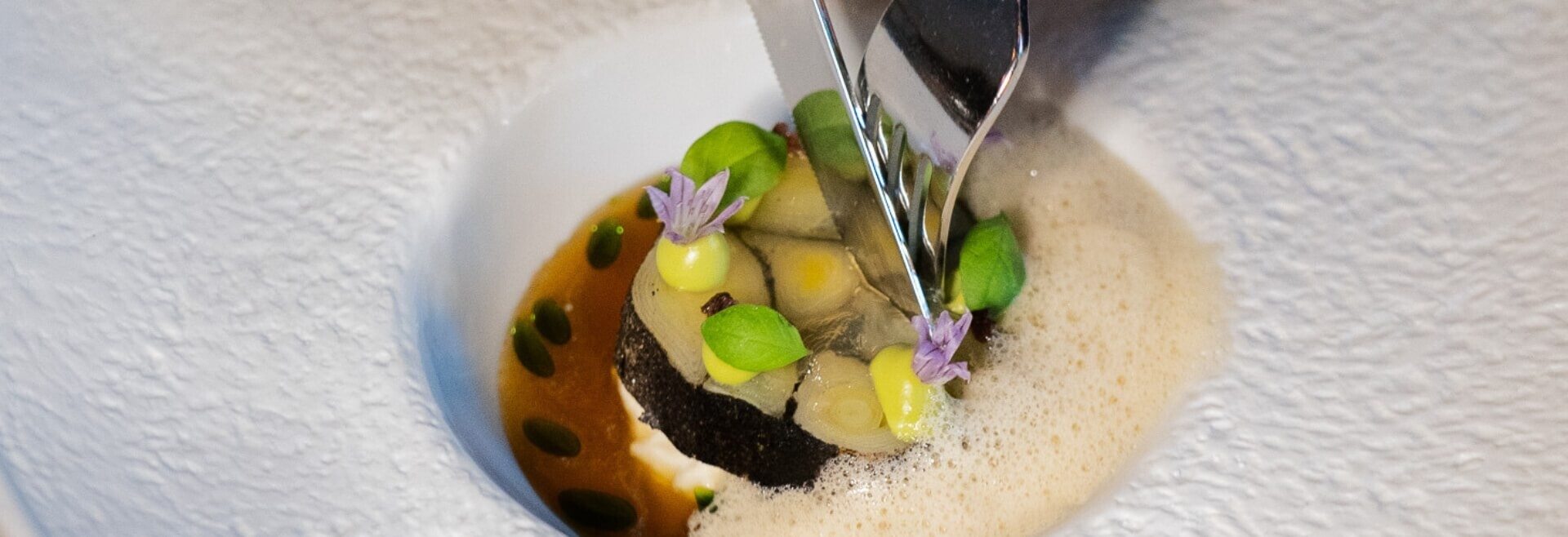
This development shows itself particularly in high-end gastronomy. More and more top chefs in Berlin use the versatility of fermentation, smoking, steaming, and aging to elicit flavor dimensions from vegetables, mushrooms, and herbs that effortlessly outshine classic meat dishes. It is no longer about renunciation or imitating known dishes, but about a full-fledged, independent enjoyment experience. The Berlin scene has proven that purely plant-based cuisine can be spectacular, profound, and highly elegant.
We ourselves as part of this development: Our path at Bonvivant
Our own story reflects this structural change. We too noticed that deepening and consistent sharpening of the concept in times of market change are the key to success. At the beginning of 2025, we completely switched our evening offering at Bonvivant to a purely vegan menu; since 2026, our popular brunch is also completely free of animal products like milk, butter, or eggs.
We did not make this decision out of a short-term trend whim or because marketing strategists advised us to do so. We were deeply convinced that plant-based ingredients offer the perfect canvas for modern, creative top gastronomy. The confirmation followed through the steady encouragement of our guests as well as the recognition of our work in high-end gastronomy.
For us, this development underpins a central insight that seamlessly aligns with the current numbers of Berlin gastronomy: The modern generation of guests does not decide primarily by whether a restaurant carries a certain ideological label, but whether the overall experience, craft quality, and taste convince. It is less about the question of who permanently eats purely vegan, but about how unforgettable an evening at the restaurant is. The decoupling from rigid dietary doctrine toward uncompromising experience quality is the actual key to correctly understanding the developments in the market.
Retail and meat alternatives: The matter of numbers and saturation
Why then does the narrative of the failing trend persist so stubbornly? The main reason lies in the data from food retail, which is often tossed into the same pot with gastronomy without differentiation. According to the Federal Statistical Office, the production of vegetarian and vegan meat substitute products in Germany in the year 2025 decreased slightly for the first time in many years: The produced quantity fell by 1.2 percent to 124,900 tons, while the production value decreased by 2.2 percent to about 632.6 million euros.
If you read only these two numbers in isolation, that quickly sounds like a trend reversal. If you consider the historical context, however, this picture relativizes immensely: Despite this minimal damper, the production quantity of meat substitute products since 2019 (then 60,400 tons) has more than doubled. After six years with partly double-digit to triple-digit growth rates, a minimal minus of 1.2 percent is no collapse, but a textbook sign of beginning market shakeout and saturation. Similar effects can historically be observed in almost all fast-growing consumer goods segments; from organic food to plant drinks to craft-brewed beer.
The major players in food retail are also reacting to this development, but by no means with a retreat. The retail giant Rewe, according to its own statements undisputed market leader in sales and revenue with vegan products in Germany, recently restructured its assortment of over 2,300 plant-based items. With the division into the private label lines „Rewe Bio Pflanzlich" and „Rewe Beste Wahl Pflanzlich", the group pursues the goal of breaking down barriers and targetedly appealing to those customer groups who do not define themselves as vegans, but regularly reach for plant-based alternatives.
„We are considered market leader in Germany in terms of sales and revenue of vegan products."
- from an official company release of the Rewe Group
This strategic renaming and resortment is a clear sign of maturity of the market: Plant-based food moves out of the specialized niche or the isolated „health food store shelf“ right into the mainstream of daily food supply. What used to serve a highly specific subculture is today staged as a self-evident option for the broad masses. That is no sign of waning interest, but the final proof of normalization in everyday life.
Digital shift: How vegan content on social media grows up
Parallel to the numbers from gastro and retail, a look at the digital accompaniment is worthwhile. Social media has always been considered an early indicator for societal trends. Data from the analytics platform influData show: Content creators from the areas of plant-based nutrition, sustainability, and food lifestyle continue to record steady growth in Germany. The highest-reach Berlin profiles in this segment alone jointly reach a coverage of several million impressions monthly, often accompanied by double-digit monthly follower growth.
Established influencers like Vania Rösch or Philipp Steller reach hundreds of thousands of people daily. But here too, the content has profoundly changed. Where a few years ago it was primarily about self-experiments („30 days vegan“), pure shopping hacks, or simple substitute product tests, today more complex topics are in focus: Culinary inspiration, sound nutritional science, restaurant reviews, and the search for real craft. According to estimates, currently about 10 percent of people in Germany eat vegetarian or vegan. Although that remains a minority, it forms a disproportionately active, high-purchasing-power, and networked target group that significantly shapes the public discourse on food and enjoyment.
Synthesis: How the different levels connect
When looking at the results of the individual areas, the apparent contradictions quickly dissolve. The overall development can be clearly divided into three levels that follow different laws:
- The general gastronomy crisis: It affects the entire market in Berlin massively. Cost pressure and altered going-out behavior hit unprofiled businesses mercilessly, completely independent of whether schnitzel or tofu is on the menu.
- The supermarket and industrial market: After years of exponential growth, an understandable consolidation occurs in highly processed substitute products. The market matures, quality replaces quantity, unprofitable products disappear from the shelves.
- The culinary & cultural level: In major cities like Berlin, plant-based cuisine has become a firm component of everyday culture. The interest in high-quality, craft-first-class gastronomy and inspiring food content continues to rise steadily.
Anyone mixing up these levels draws wrong conclusions. A slight decline in the sale of industrial substitute nuggets in the supermarket by no means means that people no longer feel like an excellent, purely plant-based dinner in an inspiring restaurant. For gastronomy, this means: The era of pure trend is over, the era of quality begins.
What this means for your next visit with us
If you ask yourselves the question of whether vegan gastronomy in Berlin has passed its peak, our answer is: The hype phase is over, but the actual golden age is just beginning. The market sorts itself, wheat separates from chaff, and what remains is the focus on real flavor experience, creativity, and hospitality. We at Bonvivant look forward to continuing to shape this path and showing how exciting purely plant-based cuisine can be.
FAQs - Frequently asked Questions
- Are many vegan restaurants currently closing in Berlin?
- No. While there are isolated closures that are normal within the framework of general gastronomy change, overall the number of vegan and vegan-friendly addresses in Berlin continues to grow (most recently by approx. 7 % year-on-year).
- Why has the production of meat substitute products dropped slightly?
- After a multiplication of production quantities since 2019, the market for packaged substitute products is experiencing normal consolidation at a very high level (-1.2 % in the year 2025 according to the Federal Statistical Office).
- Is the trend toward vegan nutrition in gastronomy over?
- The pure „hype“ gives way to sustainable normalization. In demand today are less pure substitute products, but rather craft-demanding, flavor-convincing dishes and clear culinary concepts.
- Does Bonvivant exclusively offer vegan dishes?
- Yes, both our fine-dining evening menu and our weekend brunch are completely purely plant-based.