

Piping hot, fresh off the stove - for most of us, this is the very definition of a perfect dinner. In everyday life, we tend to associate cold dishes with a quick lunchtime salad or yesterday's leftovers. At Bonvivant, however, we use the interplay of temperatures as an essential part of our menu. In the following article, you will discover why this has absolutely nothing to do with compromise, but instead brings entirely new nuances of flavor to light.
The Inbuilt Heat Reflex: Our Evolutionary Comfort Zone
Our longing for a hot meal does not come out of nowhere. Ever since humanity mastered fire, heat in food primarily meant protection: germs were killed, tough fibers broken down, and digestion made easier. This experience is deeply ingrained in our subconscious. The aroma of a warm plate immediately signals a sense of safety and ultimate satiety to the brain. Coldness, on the other hand, is almost instinctively linked by our biological programming with stagnation or a lack of freshness.
When visiting a modern, Michelin-starred vegan restaurant in Berlin, this old habit can sometimes cause surprise. If a course is not steaming, the question briefly arises: Is this intentional? Yes, absolutely. Anyone who defines enjoyment solely through the "hot" temperature setting misses out on a vast world of aromas. In our kitchen, temperature is not a random byproduct, but a precise tool used to deliberately steer flavor.
A Little Nerd-Knowledge First: How Our Tongue Reacts to Temperatures
To understand why some creations simply taste better when cooler, let us take a short excursion into the biology of our palate. Don't worry, it won't get too technical. Our taste buds are highly sensitive sensors that are heavily influenced by the thermal state of our food. The receptor channels on the tongue, which pass signals for sweet, bitter, or savory umami to the brain, simply work inaccurately at extreme temperatures.
| Temperature on the Plate | State of the Dish | What the Tongue Actually Perceives |
|---|---|---|
| Very hot (above 65°C) | Fresh from the oven or pan. | The heat slightly numbs the taste buds. Subtle nuances are lost in the steam; you primarily taste salt and fat |
| Room temperature (20°C - 35°C) | Cooled down, relaxed, pleasantly tempered. | The taste buds run at full speed. Complex ferments, fine oils, and spices reveal their complete flavor profile |
| Targeted chill (4°C - 10°C) | Deliberately chilled (e.g., soups or sorbets). | The perception of heavy sweetness and bitterness is muted. The focus shifts entirely to texture and a clean acidity |
When a plate is served piping hot, the rising steam certainly provides an intense aroma, but only a fraction of the delicate nuances reach the palate. The food feels heavy, losing its subtle undertones. It is only when we lower the temperature that we grant the ingredients the space they need to unfold completely.
Plant-Based Avant-Garde: A Concrete Example from the Pass
In classical fine dining featuring meat and fish, heat plays a leading role in softening connective tissue and rendering fat. When it comes to the demanding realm of plant-based fine dining, completely different rules apply. If you permanently subject fresh seasonal vegetables to high heat, they lose their structure, their vibrant color, and, above all, their delicate inherent flavor.
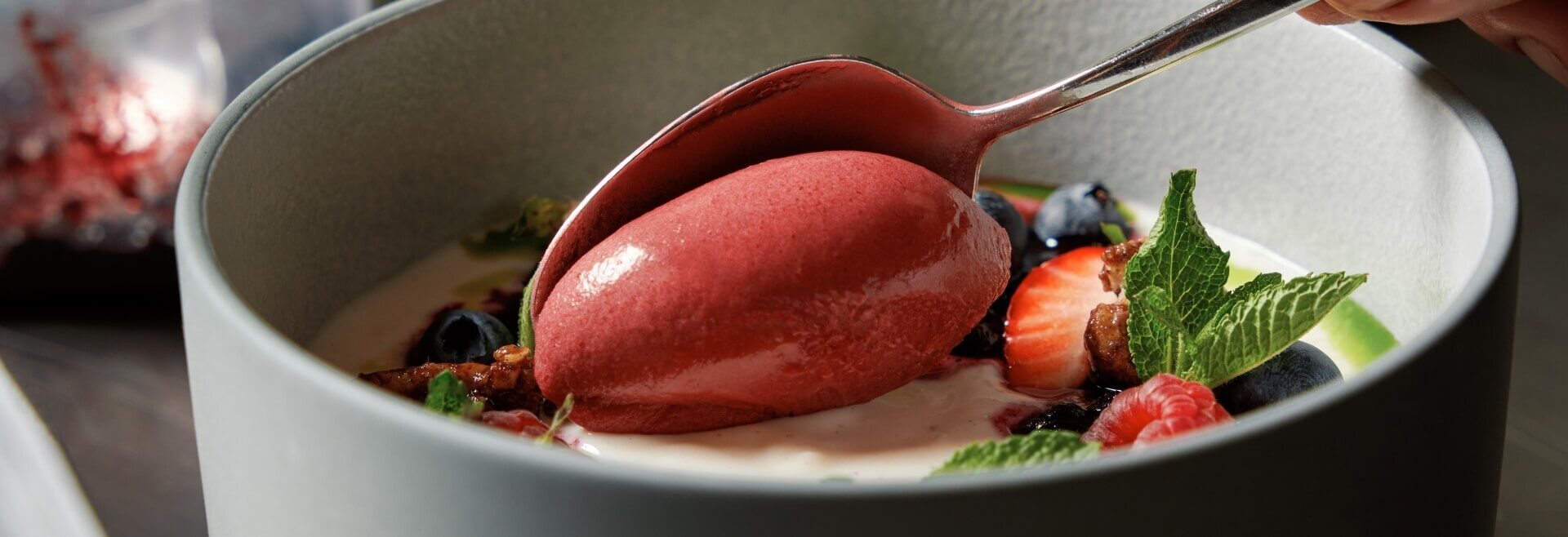
In our tasting menu, we therefore use targeted temperature shifts as a core design element. A course might begin wonderfully warm, only to surprise you at its core with a cool vegetable essence or a refreshing herb sorbet. This deliberate contrast keeps the palate awake. The brain is broken out of its routine and begins to decode subtle nuances anew. A cooler component brings a vibrancy and freshness to the plate that could never be generated with pure heat. It is all about preserving the product's crispness and original identity.
“Serving a dish deliberately cool often requires much more intuition and precision in a professional kitchen than simply braising it hot. At cooler temperatures, you cannot hide mistakes behind heat or a lot of salt, the quality of the ingredient is completely exposed.”
The Interaction with the Bar: Martin's Temperature Challenge
This philosophy does not stop at the kitchen door. The entire experience in the dining room only functions when the drinks and the food speak the exact same language. For our bar manager, Martin, this means sensitive, meticulous alignment, because every temperature shift on the plate alters the requirements for the pairing.
If Martin were to serve a classic, ice-cold cocktail over lots of ice alongside a cooler, filigree course, the cold would instantly numb the guest's taste buds. The subtle aromas of the dish would be dead on arrival. The bar team therefore coordinates the pairing precisely, often deliberately working with moderately tempered drinks, unchilled infusions, or pairings served at a mild cellar temperature for these specific courses. The goal is to balance the bitter notes, sweetness, and acidity of the liquid accompaniment so that it elegantly envelops the food and refreshes the palate without thermally numbing it. This is true, precise craftsmanship at the intersection of kitchen and bar.
Trusting Your Own Senses: A New Taste Experience
The modern food culture in Berlin thrives on breaking free from old dogmas and simply testing what tastes good. Parting with the compulsion that every plate must steam opens the way for entirely new moments of enjoyment.
The next time you sit at a table with us in the Schöneberg Akazienkiez and have a dish in front of you that radiates no heat, take a brief moment. Pay attention to how the aromas change in your mouth as the food slowly warms up and the entire spectrum of flavor unfolds.
Anyone wishing to experience a truly progressive vegan restaurant in Berlin must be willing to play with temperatures. Ultimately, it shows that the most exciting discoveries are often made exactly when you step off the beaten path and give the kitchen the room to play across the entire keyboard from warm to cool.
Anyone wishing to experience a truly progressive vegan restaurant in Berlin must be willing to play with temperatures. Ultimately, it shows that the most exciting discoveries are often made exactly when you step off the beaten path and give the kitchen the room to play across the entire keyboard from warm to cool.
FAQs - Frequently Asked Questions
- Are the dishes at Bonvivant all cold or raw then?
No, not at all. Our menu offers a well-balanced mix of warm, lukewarm, and cooler courses. Our goal is not to banish heat completely, but to use it selectively where it benefits the ingredient. We utilize cold or room-temperature elements as a deliberate contrast to keep the menu varied and vibrant.
- Why does a cooled-down dish sometimes taste better to me than a hot one?
This is because your taste buds are slightly numbed at extreme temperatures above 65°C. As the food cools and approaches room temperature, the receptors on the tongue relax. This allows you to perceive delicate acids, herbal aromas, and the natural sweetness of vegetables much more clearly and multi-facetedly.
- Does the bar really match its drinks to the food in terms of temperature?
Yes, this is a core component of our pairing concept. Martin and the bar team pay very close attention to how a cocktail is served when developing the drinks. A drink that is too icy would instantly block the tongue from experiencing the kitchen's subtle, plant-based nuances. Therefore, the temperature of each drink is chosen so that it perfectly accompanies the food and allows the flavors to flow seamlessly into one another.