
The Rebellion on the Plate: An Introduction
In a world shaped by global supply chains and the constant availability of everything at all times, true, uncompromising seasonality almost feels like a rebellious act. Anyone buying strawberries in the supermarket in February often buys that convenience at the total loss of flavor, ethics, and a connection to nature. For us at Bonvivant Berlin, seasonality is not a marketing buzzword; it is the absolute DNA of our plant-based fine dining. Cooking seasonally means far more to us than simply writing an asparagus menu in May because "that's just what you do." It means accepting nature as the ultimate pacemaker. We submit to the rhythm of the earth. Even if that means we cannot serve colorful tomatoes in the depths of winter, but must instead coax the hidden soul out of a Brandenburg storage potato or a shriveled beet. It is the art of finding the absolutely extraordinary in the seemingly simple. This radicalism requires courage, for it also means forgoing the supposed diversity of the global market in favor of a deep, regional honesty.
The Psychological Value of Limitation
Why do we do this to ourselves? In modern gastronomy, it is theoretically easy to fly in prime products from all over the world year-round. But we believe that it is precisely limitation that fuels creativity. When you only have ten ingredients at your disposal, you have to understand those ten ingredients to perfection. The creative friction that arises when you have to extract three different textures and flavor profiles from a single black salsify leads to innovations that would never emerge in a world of abundance. This radicalism creates a new form of luxury. True luxury in 2026 is no longer defined by the import of goods like lobster or foie gras. Today, luxury means knowledge, time, and origin. When we can explain to our guests which small farm in Brandenburg the pumpkin came from and how we accompanied it through various stages of maturation over three months, an emotional connection to the food is born. Seasonality forces us all to live in the moment again. You might not be able to eat the dish you love today in four weeks because nature has moved on. This makes a visit to Bonvivant a fleeting but intense snapshot in time.
The Marcher Terroir: Why Brandenburg Sand is a Blessing
We are often asked why we are so obsessed with regional products from the Berlin area. The answer lies beneath our feet: in the Marcher sandy soil. Geologically speaking, Brandenburg is a challenge. The soil is barren, dry, and nutrient-poor; in agriculture, it is not called the "dust bowl" for nothing. At first glance, this landscape seems unproductive, almost hostile to the desire for opulence. But this is exactly where the secret of flavor lies. Plants that grow on barren soils have to fight. They strike deeper roots to reach water and minerals. This "stress" ensures a concentration of aromas. A Brandenburg carrot or a root parsley from the surrounding area often has a much higher density of essential oils and natural sugars than a plant raised in a turbo-process on fat, over-fertilized soils. When we speak of seasonality thought radically at Bonvivant, we also mean the appreciation of this specific, Marcher character. We don't just cook with vegetables; we cook with the terroir of our home. It is the rugged beauty of Brandenburg that you taste on our plates.
The "Hungry Gap": Mastery of the Pantry
Anyone can cook seasonally in June. When the fields of Brandenburg are almost buckling under the weight of berries, peas, and young herbs, the culinary world is in abundance. But the true mastery of a vegan Michelin-starred restaurant shows itself during the time we call the "Hungry Gap" in gastronomy. It is the phase in late early spring, usually between March and late April. The storage cellars are swept clean, the last stored beet has been processed, and the ground outside is still too cold to bring forth new life. This is the time that separates the wheat from the chaff. While many restaurants now quietly fall back on imported goods from the far south, we remain radical at Bonvivant. This period forces us to plan our provisions with a precision bordering on alchemy. We reach into our "treasure chamber": ferments we started in late summer, vinegars aged for months, and dried mushrooms that now provide the necessary depth. For us, the Hungry Gap is not a dry spell, but a time of the most intense creativity. It teaches us humility before the cycle of nature and turns the first sprout of wild garlic or the first radish bulb into an event of festive intensity.
Archivists of Flavor: Craftsmanship Behind the Scenes
A visit to Bonvivant is a snapshot, but the work on a single dish often begins months in advance. We see ourselves as archivists of flavor. When the tomatoes have reached their full sweetness in August or the elderberries smell most intense in July, our team is in "preservation mode." We capture the sunrise of summer to bring it to the plate in winter as a warming light. We use techniques like dehydration to capture the pure essence of mushrooms or fruits. We set up garums - highly intense seasoning sauces - where we use koji cultures to break down plant proteins over weeks and months. The goal is to "freeze" summer for the winter. When you eat a dish with us in December that tastes like the bright, clear aroma of summer herbs, that is the result of this meticulous preparation. This knowledge of time is what makes our vegan cuisine so complex. We exchange the quick fat of animal products for the slow depth of artisanal maturation. Fermentation is not a trend for us, but a necessity to create an umami density that leaves the guest in awe without animal aids.
Root-to-Leaf: Our Vision of Zero Waste
Radical seasonality is incomplete without a consistent zero-waste philosophy. When we receive a product like cauliflower or celeriac from one of our partner farmers, we view it as a whole. In classical kitchens, half of the vegetable often ends up in the trash - peels, leaves, root ends. At Bonvivant, that is unthinkable. We practice the "root-to-leaf" approach not only out of ecological conviction, but because the most intense flavors often hide in the supposed waste. From the carrot peels, we extract roasted oils that possess a depth the core of the vegetable lacks. The greens of fennel or radishes are processed into highly concentrated emulsions, and from the hard stalks of cabbage, we create stocks that develop a deep dark color and a complex, hearty umami intensity through heavy roasting and long simmering. This serves as a powerful, purely plant-based base that shows just as much character in its aromatic concentration as a classic jus. Even the seeds of pumpkins are roasted, pressed, or processed into miso-like pastes. This holism is a tribute to the product and the work of the farmer. It is our way of saying: every fiber of this food is precious. This process requires more time and more staff, but the result is a flavor profile that is multidimensional and honest. It is culinary sustainability that you can't just see, but taste down to the very last nuance.
Our Product Knowledge: Stars of the Season (May Edition)
In May, nature literally explodes, and we can hardly wait to bring the first fresh green messengers into our restaurant in Schöneberg. Here are our current favorites:| Ingredient | Why we love it | Our interpretation at Bonvivant |
|---|---|---|
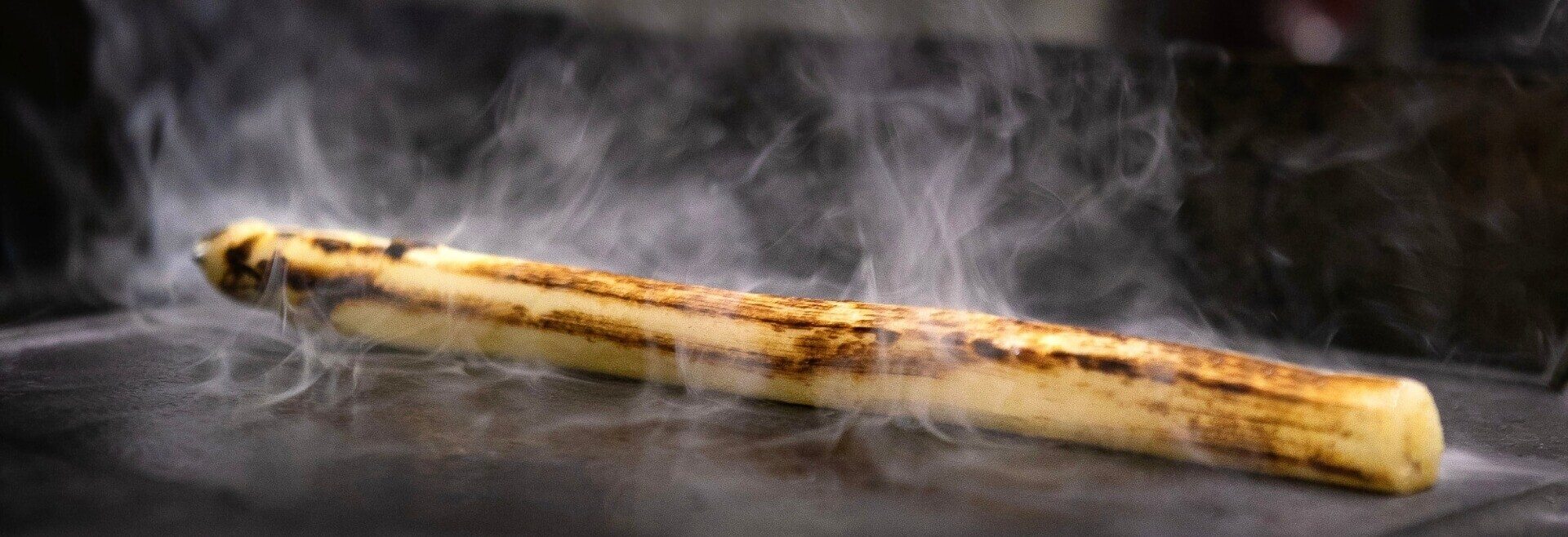
| Asparagus (White & Green) | The epitome of spring. We love the nutty intensity | We sear the white asparagus hard for smoky roasted notes |
| Rhubarb | The perfect acidity component and spring awakening | Processed into fermented cordials or as an acidic counterpart in the main course. |
| Kohlrabi | Tender as an apple, a must for fresh textures | Thinly marinated carpaccio combined with intense vegetable broth |
| Broccoli | Wild broccoli is finer and more aromatic | Briefly sautéed with umami-rich creams made from regional nuts |
The Bar as a Partner to Culinary Art: Liquid Fine Dining
Our philosophy does not end at the edge of the plate. At our award-winning bar, we continue this principle consistently, with the kitchen and bar working hand-in-hand in the spirit of holistic sustainability. We process food as a total work of art. In many establishments, the kitchen and bar are separate worlds; with us, they merge. When we extract the full aroma of a fruit in the kitchen, we often use the resulting essences as a base for our complex cocktails. We work with vacuum distillation to capture volatile aromas that would be lost during normal cooking. This synergy is the core of our zero-waste philosophy in Berlin-Schöneberg. Through fermentation, we preserve the peak season to make these aromas accessible to you all year round. A drink for us is not a mere accompaniment; it is the liquid continuation of the plate. Those who order a pairing with us experience a dialogue between glass and porcelain that is unique in this form.
The Carrot as a Prime Cut: A New View of the Product
We must redefine the concept of luxury. For a long time, luxury was seen as the availability of the rare and expensive. At Bonvivant, we flip this principle. For us, luxury is the maximum proximity to the origin. It is the absence of the superfluous. It requires far more artisanal skill to conjure a dish from a simple, sandy carrot that touches a guest emotionally than to sear an expensive piece of meat. The carrot is our "filet" cut. We treat it with the same respect: we braise it in its own juice, we glaze it, we use its greens for emulsions and its skin for roasted extracts. This focus on the essential sharpens the senses. Our guests don't come to us to repeat what is familiar. They come to experience how we push the boundaries of plant-based cuisine and give a stage to seemingly simple products through precision and time, in a way that can only be found at Bonvivant. It is about discovering complexity in the everyday. When a guest pauses after the first bite of a root parsley because they have never experienced this aroma so purely, we have achieved our goal.
The Guest as a Confidant: Why Transparency is the New Etiquette
In classical fine dining, the kitchen was often a closed fortress. The guest saw the result but not the process. We believe that seasonality only unfolds its full power when we make the guest a confidant. When we serve, we tell stories not just of ingredients, but of moments in time. We open the doors to our philosophy and invite everyone to become part of this process. We explain why the asparagus has a different texture today than three days ago, or why the spiciness of the radish greens harmonizes with the earthy tone of the kohlrabi. This form of knowledge transfer is not lecturing, but a sharing of enthusiasm. Today's guest wants not only to be satiated but to be inspired. They want to understand why we chose the Marcher sand carrot and which person stands behind this product. This transparency creates trust and a deep appreciation for the craft. It is the difference between "going out to eat" and "understanding the food."
The Aesthetics of Nature: When Colors Set the Pace
Thinking about seasonality radically also means adapting the visual identity of the restaurant to nature. Our plates follow no rigid color concept, but rather the color scheme of the seasons. In winter, earthy tones and the deep violet of beetroot dominate. It is a warm, heavy aesthetic that conveys a sense of security when it is gray and cold outside in Schöneberg. With the arrival of spring, our palette changes almost overnight to an electrifying green, delicate white, and vibrant pink. This visual freshness is the direct reflection of the vitality in the fields. We use no artificial dyes; the radiance of a freshly pressed herb emulsion or the deep blue of fermented red cabbage are the authentic colors of Brandenburg. For our guests, this means: seasonality is experiential with all senses in our Schöneberg neighborhood. When spring glows on the plate, you physically feel the change of season.
The Future of Enjoyment: An Outlook
Radical seasonality is not a passing trend for us, but the only answer to the ecological and culinary challenges of our time. We are only at the beginning of a movement that fundamentally redefines the relationship between humans, nature, and gastronomy. The future belongs to a cuisine that no longer sees itself as the conqueror of nature, but as its partner. At Bonvivant, we see it as our task to further expand this pioneering role. In the coming years, we will deepen our cooperation with local producers even further, rediscover old varieties that have almost been forgotten, and further perfect our preservation techniques. We want to show that purely plant-based, radically regional cuisine is not a niche, but the center of a new, conscious fine dining. It is about combining enjoyment with responsibility without losing even a millimeter of flavor or elegance. Bonvivant is a place of experiment, of change, and of the tireless search for the true taste of Brandenburg.
A Plea for Patient Enjoyment
Seasonality requires patience - from us as a host team, but also from you as guests. It is the anticipation that makes the taste truly intense. Anyone who waits nine months for the first real Brandenburg asparagus or the first vibrantly fresh kohlrabi experiences an explosion with the first bite that no greenhouse product could ever offer. In a world of instant availability, this waiting is a luxury good. At Bonvivant, we defend this luxury every day. We invite you to engage with this rhythm. Forget the standardized cuisine of mass production. Immerse yourself in a world that turns and never stands still. Seasonality is not a constraint; it is the greatest freedom we have as restaurateurs and gourmets. It is the freedom to taste the truth of nature.
FAQ - Frequently Asked Questions
What exactly does "radical seasonality" mean at Bonvivant?Radical for us means that we consistently subordinate ourselves to the rhythm of the region. If an ingredient is not currently in season in Brandenburg, it does not find its way into our kitchen, even if it were available globally. We replace the lack in winter with artisanal techniques such as fermentation, pickling, and dehydration.
Does Bonvivant only offer vegan dishes?
We see ourselves as pioneers for plant-based fine dining. Our menus are purely plant-based. Through koji and house-made garums, we achieve a flavor intensity that convinces even lovers of classical cuisine without animal products being missed.
What is special about your cocktail pairing?
At our bar, we practice Liquid Fine Dining. Cocktails on an equal footing with the dishes, often using the same regional raw materials. This creates a flavor synergy that goes far beyond a classic drink accompaniment.
Where do you source your products?
We maintain close partnerships with organic farms in the Berlin area (e.g., Ökodorf Brodowin). Short distances guarantee freshness and support sustainable agriculture that respects the Marcher terroir. Come by and taste the spring at Bonvivant. We look forward to showing you what the surrounding area currently has to offer - radical, honest, and damn delicious.