


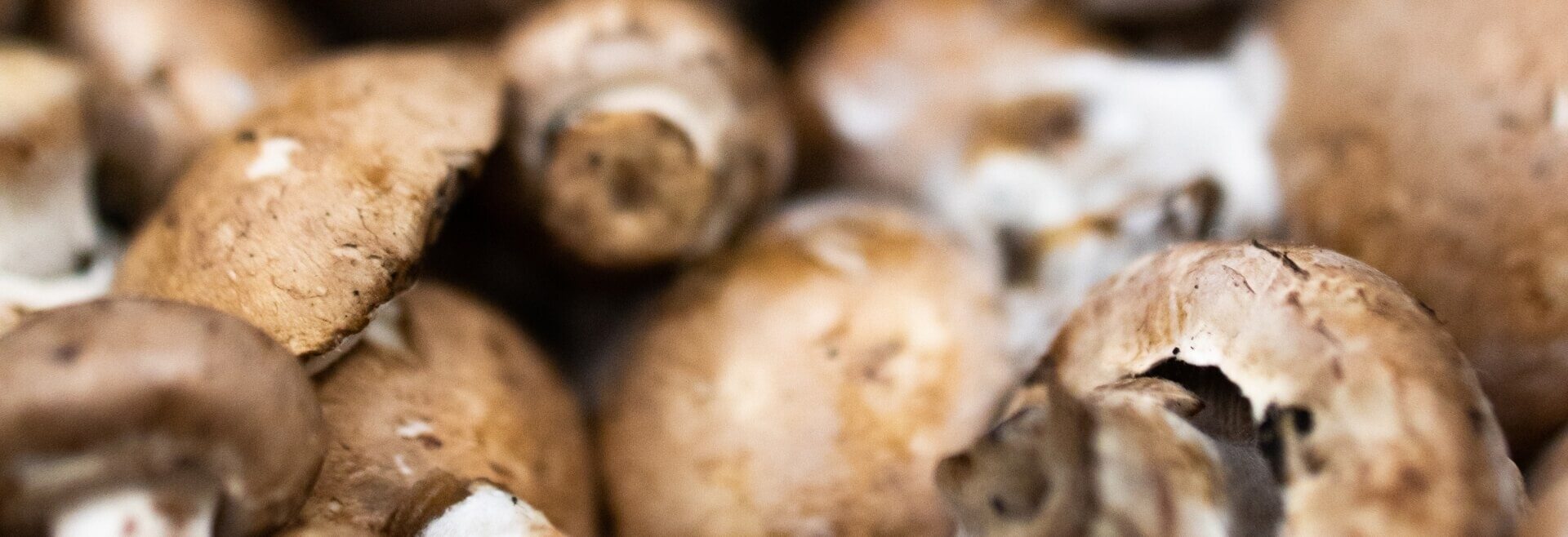
Why mushrooms are so important to our kitchen
Mushrooms are considered one of the best plant-based alternatives to meat because they deliver depth, heartiness, and texture. For a vegan kitchen, they are therefore an ongoing topic. In this context, we clearly distinguish between what we find in the forest ourselves and what we source from partners. With Martin Rötzel, who is known under the name The Monk Garden, we have attended several wild herb and mushroom courses and learned a lot about identification, processing, and even vital mushrooms as a regional coffee alternative. The most important realization from these courses is uncomfortable: mushroom foraging is not a beginner's hobby for a first walk, but demands knowledge, patience, and humility.
What is allowed in Berlin
The forest laws of the states of Berlin and Brandenburg allow the gathering of mushrooms only in small quantities for personal use. A fixed maximum quantity is not specified in any law. One to two kilograms per person per day serves as a guideline, meaning a well-filled small basket, and by no means several baskets from the trunk of a car. Anyone taking larger quantities or selling mushrooms risks a fine; commercial gathering is prohibited. In nature reserves, gathering is forbidden, and a strict requirement to stay on designated paths applies there, so you must not leave the paths. This also applies to partial areas of popular city forests such as Grunewald or Köpenicker Forst. Before you head out, it is therefore worth taking a look at the maps of the Berliner Forsten to check where protection boundaries run. Furthermore, some mushroom species may not be gathered at all.| Situation | Rule |
|---|---|
| Regular forest areas in Berlin and Brandenburg | Small quantity for personal use, as a guideline one to two kilograms per person per day |
| Nature reserves | Gathering forbidden, additionally strict requirement to stay on paths |
| Commercial gathering and sale | Forbidden, fines possible |
| Particularly protected species | May not be gathered |
The most important rule: only eat what is identified beyond doubt
The death cap also grows in Berlin's forests, and even small amounts of it can be fatal. It is considered one of the most poisonous native mushrooms, accounting for around 90 percent of fatal mushroom poisonings. Confusion is particularly treacherous, for example with the field mushroom. And the symptoms often appear only after hours: in acute death cap poisoning, they usually begin between four and 48 hours after consumption, after which they seemingly subside before liver damage occurs. If you are not completely sure, leave the mushroom standing, no matter how appetizing it looks and even if an identification book or an app seemingly gives the all-clear. Should something still not be right after a mushroom meal, every minute counts. In case of suspected poisoning:- Call emergency services at 112 or the poison control center for Berlin and Brandenburg at 030 19240, which is reachable around the clock.
- Keep remnants of the mushroom meal and vomit so they can be examined.
- Do not apply any home remedies.
Free mushroom advice at the Botanical Garden
Berlin has an offer that many do not know about: the mushroom advisory service at the Botanical Garden and Botanical Museum in Dahlem has existed since 1890, and since 1935 it has been the state of Berlin's only mushroom information office. Here you can have gathered mushrooms checked free of charge by trained mushroom experts. One rule emphasized by the advisory service itself is important here.„Please never bring individual mushrooms as ‚representatives‘ while withholding the rest of the collection."The reason is simple: mushrooms that look identical are often not the same species after all. Therefore, only mushrooms that were actually presented are cleared for consumption. Bring your finds as fresh and complete as possible, sorting out severely maggot-infested, moldy, or very dirty specimens beforehand. Consultation hours can change at short notice and waiting times may occur during peak season, so check the Botanical Garden's website in advance. Further advisory services exist at the Pilzkundliche Arbeitsgemeinschaft Berlin-Brandenburg, among others, and the German Mycological Society lists certified experts in Berlin. BUND-certified mushroom experts also offer free consultation hours in Berlin.
- Mushroom Advisory Service at the Botanical Garden Berlin
Your checklist before the forest walk
A good mushroom hunt begins at home. Check beforehand whether you will be traveling in a nature reserve, and plan the visit to the mushroom advisory service right away, because without an expert afterward, every find remains a risk. Pack a breathable basket, a small knife, and an identification book; your cell phone should be charged in case you need to orient yourself in the forest. And set a limit for yourself in advance that you do not exceed, so that a walk does not turn into a violation.
How to harvest correctly
Anyone who does not know a mushroom with certainty should harvest the entire fruiting body including the base of the stem, as this is an important identification feature. It is best to lift the mushroom carefully out of the ground. Transport is done in a breathable basket in which the mushrooms can lie without being crushed. Gathering in wet weather is unfavorable because the mushrooms mold faster then. Known species can be roughly cleaned directly in the forest, leaving soil and maggot-infested parts there. Only the fruiting body is harvested; the actual fungal network in the ground, the mycelium, remains undamaged. Nevertheless, some species are endangered in their population, so the rule is: gather in moderation, behave quietly, and respect other plants and animals.
From the forest to the plate
Anyone who comes home with a cleared basket after mushroom advice faces the most beautiful task. Mushrooms unfold their aroma through searing, roasting, or grilling, creating roasted aromas and the typical hearty depth. Wild mushrooms should always be cooked thoroughly and not eaten raw. In addition, many species are suitable for drying or pickling, allowing autumn to be preserved, similar to how we described it in our seasonal calendar. The mushroom also plays a role at the bar. For example, with oyster mushrooms served with hazelnut, horseradish, kohlrabi, and pine, we served a drink made of sherry, apple verjus, herbs, and ume su. You can find more about this mindset in our article on balanced drinks.
Mushrooms and sustainability
Mushrooms are protected under conservation law in Germany, meaning gathering is allowed only in small quantities. According to conservationists, the main problem for many species is not gathering, but soil over-fertilization, nitrogen and phosphate pollution, the replacement of mixed forests with monocultures, and the destruction of natural habitats. Anyone who gathers responsibly and utilizes their finds consciously thus contributes only a small part, but one that counts.Anyone who delves deeper into gathering quickly encounters ecological and legal subtleties that go beyond mere harvesting. The Federal Nature Conservation Act (BNatSchG) in conjunction with the Federal Species Protection Ordinance (BArtSchV) generally places native wild mushrooms under protection. Exceptions apply to popular edible mushrooms such as porcini, chanterelles, birch boletes, or morels: they may be harvested exclusively in small quantities for personal use. Other species, such as true truffles, remain strictly protected without exception and may not be gathered at all.
Another factual aspect concerns the contamination of fruiting bodies by environmental toxins. Mushrooms possess the ability to accumulate heavy metals such as cadmium or lead as well as the isotope cesium-137 stemming from past environmental contamination from the soil. This applies particularly to long-lived mycorrhizal fungi that live in symbiosis with tree species and whose subterranean mycelium absorbs nutrients over large areas.
In urban agglomerations and along busy roadways, the accumulation of pollutants is generally higher than in undisturbed forest areas. From a health perspective, it is therefore advisable to avoid finds from the vicinity of roads or industrial areas. Knowing these scientific facts and legal framework conditions makes it clear why mycological knowledge not only protects against poisonings, but also contributes to a reflective, resource-saving interaction with nature.
What this means for your visit with us
When you discover mushrooms on our menu in autumn, you now know how much knowledge and care can go into a single mushroom. Anyone who wants to experience this for themselves will find all information about the current menu on our page.
FAQs - Frequently Asked Questions
How many mushrooms are you allowed to gather in Berlin?Only a small quantity for personal use. No law names a fixed maximum quantity; one to two kilograms per person per day serves as a guideline.
Where are you not allowed to gather mushrooms in Berlin?
In nature reserves, where a requirement to stay on paths also applies. This also affects partial areas of forests such as Grunewald or Köpenicker Forst.
Is there free mushroom advice in Berlin?
Yes, at the Botanical Garden and Botanical Museum in Dahlem, where the mushroom advisory service has existed since 1890. Consultation hours can change, please check in advance.
What to do if mushroom poisoning is suspected?
Immediately call emergency services at 112 or the poison control center at 030 19240 and keep remnants of the meal.